



Osteoarthritis of the hip joint is today considered one of the most common diseases of the musculoskeletal system.Its symptoms cause severe discomfort to the patient and limit physical activity, and the treatment is long.
In severe cases, the disease leads to disability.Osteoarthritis of this location is also known as coxarthrosis.With this disorder, the hip joint suffers from chronic inflammation.Its cartilaginous tissue is destroyed and the joint space narrows, which leads to a significant decrease in the mobility of the leg.
The disease develops more often in older patients, but is sometimes diagnosed in young people.
The essence of the disease
The hip joint is the largest joint in the human body.It is located at the junction of the femur bones with the pelvis, therefore it bears a significant daily load.The joint itself has the appearance of a ball joint: the rounded head of the femur is located in the hemispherical acetabulum of the pelvis.The surface of the bone tissue is covered with durable and highly elastic cartilage.It plays the role of a shock absorber and also ensures problem-free sliding of the bones.Cartilage tissue prevents destruction of the femurs and pelvis.
With coxarthrosis, the cartilage begins to thin and collapse and, as a result, the bone tissues come into contact with each other.Slipping becomes difficult and painful.Movements become limited.Further progression of the disease leads to more pronounced destructive changes: the bone surfaces are covered with growths (they arise due to constant injuries), which further complicates the movements of the joint.
Reasons
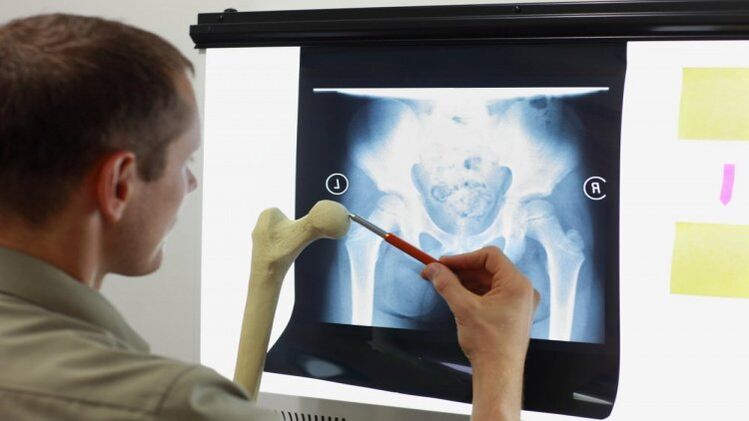
There are many known factors that can lead to coxarthrosis.This disease can occur due to:
- congenital joint pathologies (dysplasia), which can remain undiagnosed for many years of life;
- premature wear of joint mechanisms, which is explained by excessive loads (during intense sports or excess body weight);
- previous injuries;
- infectious processes affecting the functions of the musculoskeletal system;
- improper blood supply to the joint (for example due to atherosclerosis);
- spinal diseases;
- hormonal disorders;
- rheumatic processes, etc.
Identification of the causes of arthrosis of the hip joint allows you to prevent further development of the disease, select the most comprehensive treatment and relieve unpleasant symptoms.
Symptoms
Signs of coxarthrosis directly depend on the degree of degenerative processes in the articular body.In total, doctors distinguish 3 main stages of the disease:
- Stage 1. With this condition, the patient is bothered by periodic pain in the groin area.They are caused by physical activity, prolonged walking and static position.Once you rest, the discomfort goes away.Therefore, patients do not perceive them as a reason to consult a doctor.And the disease develops further.
- Stage 2. At this stage of development, coxarthrosis causes more pronounced pain.Pain occurs even after minor exertion.The patient begins to limp and the discomfort radiates to the inner thigh area.The affected joint may break.Most often, arthrosis at this stage limits motor activity and leads to a decrease in muscle strength.
- Phase 3. In this phase, coxarthrosis reaches a stage of development that makes the patient's life almost unbearable.The pain becomes constant and intensifies even due to small loads.A person with the third stage of arthrosis of the hip joint is forced to use a cane.In this case, the problem leg is often shortened, which is explained by distortion of the pelvis and spine.Muscles atrophy.The third stage of the disease leads to a significant deterioration in the general condition.Constant pain interferes with sleep and causes depression.
Some doctors separately distinguish stage 4 of coxarthrosis, in which the affected joint becomes completely immobile.
You can see the development of arthrosis of the hip joint on a regular x-ray.When the pathological process just begins to develop, the joint space narrows slightly and small, isolated bumps can be found on the bone tissue.At this stage of development, the disease can be managed using conservative methods.If coxarthrosis leads to deep deformation of the joint and touching of bone surfaces (which is typical of the third stage of the disease), the normal state can be restored only with the help of surgery.
Non-pharmacological treatment

Patients with arthrosis of the hip joint are advised to relieve the affected joint as much as possible.For this purpose it is necessary:
- avoid running, walking for long distances, jumping, lifting heavy loads and remaining in the same position for a long time;
- wear special shoes with well-cushioned soles;
- also lean on a cane or crutch (it must be taken in the hand opposite the affected joint).
To reduce pain and improve the functioning of the joint system, it is recommended to regularly perform physiotherapy exercises.Simple exercises help strengthen muscle tissue, which gives excellent long-term results.If you are overweight, you need to go on a diet and get rid of those extra pounds.
Pharmacological treatment
Conservative drug treatment for arthrosis of the hip joint is selected on an individual basis;therapy largely depends on the symptoms of the disease and the results of diagnostic procedures.As a rule, patients are prescribed:
- Non-steroidal anti-inflammatory drugs.They help relieve pain in the affected joint;
- Steroid (hormonal) drugs.They are used when non-steroidal drugs are not effective enough;
- Muscle relaxants that reduce muscle tone and help eliminate pain;
- Vasodilators.It may be necessary if blood circulation in the joint is insufficient;
- Chondroprotectors that promote the restoration of joints and prevent their further destruction.
Conservative treatment of the joint can be supplemented with the use of the latest medical techniques.Patients may be offered plasma facelift procedures, physiotherapeutic treatments and balneotherapy.All these methods of influence are practiced only after the acute inflammatory process has been eliminated.
Balneotherapy for coxarthrosis
Patients suffering from coxarthrosis can benefit from cycles of balneotherapy, in particular mud therapy.Such procedures can be performed in regular clinics, private clinics, rehabilitation centers and sanatorium institutions.Mud is widely used in the treatment of diseases of the musculoskeletal system.In case of arthrosis of the hip joint, mud treatment helps to reduce the inflammatory process, relieve unpleasant symptoms and slow down degenerative processes.The effectiveness of such procedures is confirmed by research by German scientists.In their article published in 2019, experts noted that a course of mud for coxarthrosis helped:
- improve the motor functions of the joint;
- significantly reduce the severity of pain (the effect persisted for 3 months after the end of therapy);
- slow the progression of the disease.
However, it is worth considering that all physiotherapeutic and balneological procedures for coxarthrosis can be carried out only after the approval of the attending physician.Such treatment of the joint must be combined with taking the prescribed medications and compliance with all restrictive recommendations.